
Table of Contents
How can electric cars be charged?
In the electric vehicle market, there is no standardization in the types of connectors for electric vehicles, users encounter different models and brands, with varying configurations and technical characteristics. For this reason, it is advisable to stay informed about the compatibilities that exist and the different types of connectors that we will find on public roads or install in our homes. The different types of connectors are:
-
Electric vehicle connector: Schuko plug (conventional plug).
It is compatible with European power outlets and complies with the CEE 7/4 Type F standard. It has a ground connection, two terminals, and supports a current of up to 16 amperes, making it only compatible with slow charging. It is common in some motorcycles and electric bicycles, and even in some electric cars like the Twizy.
-
Electric vehicle connector: SAE J1772 connector (Type 1).
It is the standard connector in Japan and has been accepted in the European Union and the American market. It has 5 terminals, two of which are for current, two are complementary, and the last one is for ground. This type of connector has two levels, one of which is up to 16 Amperes, suitable for slow charging. The other level is up to 80 Amperes, corresponding to fast charging. This connector is used to charge electric vehicles such as the Opel Ampera, Nissan Leaf, Nissan ENV200, Mitsubishi Outlander, Mitsubishi iMiev, Peugeot iON, Citröen C-Zero, Renault Kangoo ZE (Type 1), Ford Focuselectric, Toyota Prius Plug-in, or the KIA SOUL EV.
-
Electric vehicle connector: MENNEKES connector (Type 2).
It is not specific to electric vehicles but is very commonly used. It is of German origin, has 7 terminals, of which 4 are for current (three-phase), one for ground, and two for communications. In this type, we have the option of two currents, on one hand single-phase (up to 16 A – slow charging), and on the other three-phase (up to 63 A/ 43.8kW – fast charging). Suitable for models such as the BMW i3, i8, BYD E6, Renault Zoe, Tesla Model S, Volvo V60 plug-in hybrid, VW Golf plug-in hybrid, VW E-up, Audi A3 E-tron, Mercedes S500 plug-in, Porsche Panamera, or the Renault Kangoo ZE.
-
Electric vehicle connector: Combined Charging System (CCS)
. Created by Germans and Americans as a standard solution. It has 5 terminals distributed for current, ground, and communication with the network. This type of connector supports both charging (slow and fast). Manufacturers such as Audi, BMW, Daimler, Porsche, and Volkswagen already incorporate this type of connector.
-
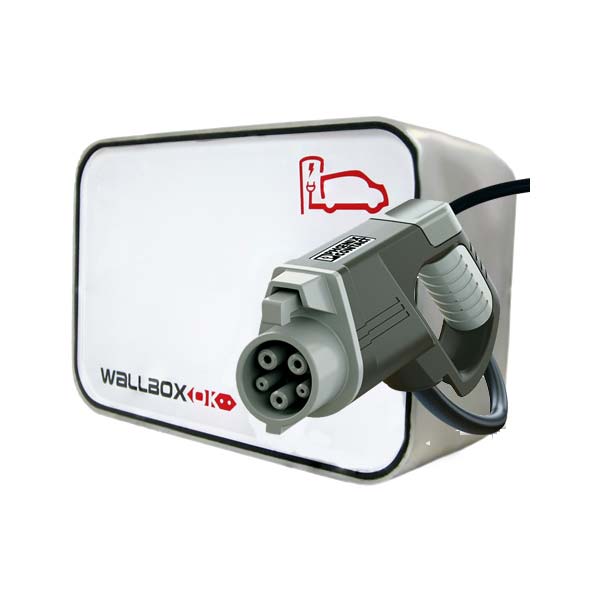
Electric vehicle connector: Scame connector (Type 3).
It has 5 or 7 terminals, depending on whether it is single-phase or three-phase, including ground and communication with the network in both. It supports up to 32 A and is for semi-fast charging.
-
Electric vehicle connector: CHAdeMO connector.
Developed by the Japanese association formed by the Tokyo Electric Power Company (TEPCO), Nissan, Mitsubishi, Fuji Heavy Industries (Subaru), and Toyota. Designed for fast charging in direct current, it has 10 terminals, ground, and communication. This connector is for ultra-fast charging, as it supports up to 200 A. It is equipped for cars such as the Nissan Leaf, Nissan ENV200, Mitsubishi Outlander, Mitsubishi iMiev, Peugeot iON, Citröen CZero, or the KIA SOUL EV.
Sources: Endesa and FAEN.