
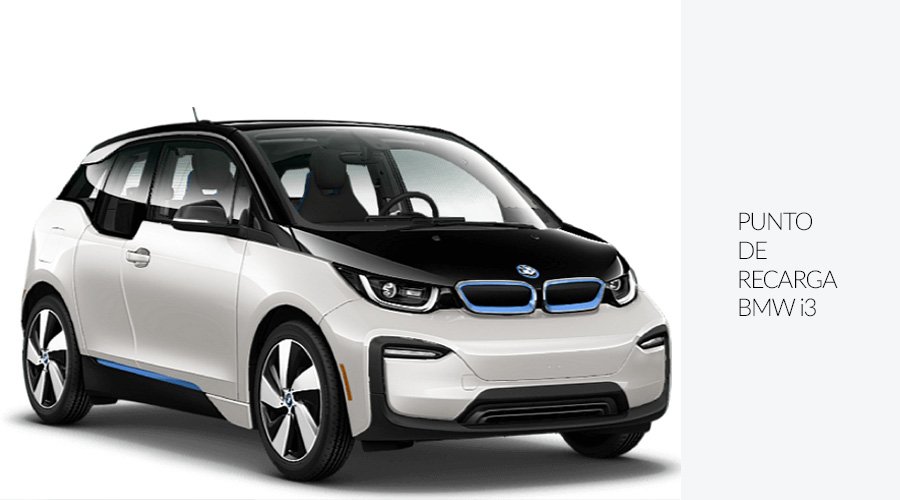
The BMW i3 is one of the most popular electric cars in Spain and Europe, and the only one available as both a pure EV and the extended-range i3 REX. A battery update in July 2016 improved the official range of the EV to 300 km from the 189 km of the previous generation, placing it among the best in its class in terms of range on a single charge. In addition to that, with this model, BMW has made a style update with a sharper design, as well as the introduction of a sportier variant of the BMW i3.
Table of Contents
How to Charge the BMW i3
The BMW i3 range uses the CCS charging standard, which consists of a combined AC and DC inlet port. This BMW electric motor car uses a Type 2 connector with a wallbox or portable charger. It can also be charged at fast AC points and public charging stations.
The upper and lower sections of the inlet are used for high-power transport during fast DC charging. The CCS charging inlet of the BMW i3 is located on the 3/4 panel at the rear outer side.
It can be charged slowly, quickly, and super fast. Slow charging requires a 3-pin to Type 2 cable, and fast charging requires a Type 2 to Type 2 cable, one of which refers to the vehicle. For fast charging, the vehicle uses a tethered CCS connector that is part of the charging unit.


Charging Process at Public and Private Chargers
Charging at AC or DC requires the EV driver to connect the connectors to the correct inlet, after which the car “talks” to the charging unit to ensure there is a power source, no faults, and that it is safe to start charging. If charging at a private charging point at home or at work, the vehicle begins to charge automatically.
At a public charger, an activation process may be required to start charging. Depending on the network provider, this may require the use of an RFID card or a smartphone app, often linked to an account that has been set up in advance. Contactless pay-per-use units are becoming more common in newer units. Once activated, the units will perform additional connections and account checks before starting to charge the vehicle.
How Long Does It Take to Charge?
The following table shows the approximate time to charge a BMW i3 94 Ah. The times are for a 100% charge for all except for fast charging, which is quoted for 0-80%, as most fast chargers reduce or taper power well before reaching 100% charge to protect the battery and maximize efficiency.
Please note that the times shown are only a guide, as it is very rare for an EV to need to be fully charged from 0%. Other factors that can vary charging time include ambient temperature, energy loads on the vehicle, any upper and lower charging restrictions to prolong battery life and protect it from potential damage, and charging rates decrease as maximum charge is approached.
| Super Fast 50kW | Fast 22kW | Fast 7kW | Slow 3kW |
|---|---|---|---|
| 35 mins 0-80% | 3 hours 0-100% | 4:30 hours 0-100% | 11 hours 0-100% |
Charging a BMW i3 at Home
It is often the most convenient and cost-effective way to recharge this electric car. Currently, there are not many charging points on public roads, and it is preferable to rely on our own charger for recharging.
Most home chargers have a power of 3 kW or 7 kW. Higher-powered wallbox or wall-mounted charging points typically cost more than the slower 3 kW option but halve the time required to fully charge an EV.
If you are thinking of buying a BMW i3 or already have one, find out here about the charging points for a BMW i3 and request information if you need a customized installation and charging point for your home or community garage.