
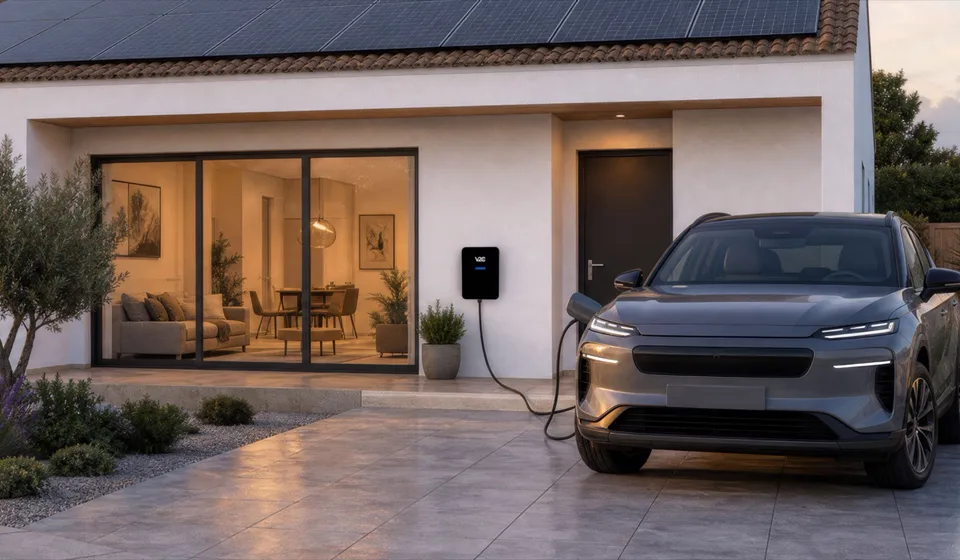
An outdoor EV charger is a home charging point built to be installed outside, with a weatherproof enclosure that resists rain, sun, dust and temperature swings, unlike indoor models that lack this reinforced protection. To last for years, it needs the right protection rating, a well-chosen position and a compliant installation.
At V2C, as designers and manufacturers of EV chargers, we know that reliable outdoor charging comes down to a few concrete figures: IP and IK ratings, temperature range, position and compliance with the wiring rules. In this guide we go through each one and show you how Trydan, Trydan Pro and Alva measure up for a home in the UK or Ireland.
Key points
- Protection: a charger survives outdoors when its enclosure is sealed against dust and water (the IP rating) and against impacts (the IK rating).
- Trydan and Alva: rated IP54 / IK10; Trydan runs from −25 to 50 °C, according to the V2C data sheet.
- The rule: BS 7671 sets IPX4 as the outdoor minimum in the UK, with IP54 recommended for fully exposed positions.
- Grants: the UK EV Chargepoint Grant and the SEAI Home Charger Grant can cut the cost, each through an approved installer.
Table of Contents
- 1 What makes a charger suitable for outdoor installation?
- 2 Which IP rating do you need in the UK and Ireland?
- 3 Wall-mounted or pedestal: which suits your driveway?
- 4 What else matters for an outdoor charging point?
- 5 Charging two cars outdoors from one point
- 6 How much does an outdoor EV charger installation cost in the UK and Ireland?
- 7 Best outdoor EV chargers compared
- 8 Finding a qualified installer for your outdoor charge point
What makes a charger suitable for outdoor installation?
An EV charger is suitable for outdoor installation when its enclosure is sealed against dust and water (its IP rating) and protected against impacts (its IK rating). These two codes, not the look of the unit, decide whether it survives year-round outside. Power and charging mode are the same as an indoor charger.
The figure to check on the data sheet is the operating temperature. Trydan, for example, works from −25 to 50 °C, so cold mornings and hot south-facing walls are both within spec. Whether you drive a full EV or need to charge hybrid car at home, the enclosure requirements are identical.
IP and IK ratings explained
The IP rating (standard IEC 60529) tells you how well the enclosure keeps out dust and water: the first digit is dust, the second is water. The IK rating (IEC 62262) runs from IK00 to IK10, the top of the scale, and measures resistance to mechanical impact, which matters outdoors where a charger is within reach of car doors, bumpers and hail. Here are the values you will see most often on a data sheet:
| Code | What it means and when it matters |
|---|---|
| IP5X | Dust-protected: a limited amount may enter without affecting operation. Outdoors: driveways and yards with dust and leaves. |
| IP6X | Fully dust-tight. Outdoors: very dusty or coastal settings. |
| IPX4 | Protected against splashing water from any direction. Outdoors: rain, including wind-driven rain. |
| IPX5 | Protected against water jets. Outdoors: jet-washing near the charger. |
| IK08 | Withstands a 5-joule impact. Outdoors: light knocks. |
| IK10 | Withstands a 20-joule impact, the top of the scale. Outdoors: accidental knocks, hail and tampering. |
Trydan and Alva are both rated IP54 / IK10: protected against dust and splashing water from every direction, with the highest impact resistance on the IK scale. The MVR polycarbonate enclosure means Trydan is ready for outdoor use with no extra housing, so you can mount it straight onto a wall or post.
Good to know
A sheltered position, out of direct sun and driving rain, extends a charger’s life more than any higher IP rating ever could.
Which IP rating do you need in the UK and Ireland?
For a sheltered wall under a canopy, IP44 is enough; for a fully exposed driveway or post facing the full force of British or Irish weather, IP54 to IP55 is the sensible choice, according to the IET Code of Practice that sits alongside BS 7671. Both sit above the legal minimum of IPX4, the real starting point for any outdoor charge point.
Sheltered wall vs. fully exposed driveway
A charger tucked under a porch or balcony sees far less water than one on an open post in the middle of a driveway. In an exposed position, rain arrives from every angle and sun hits the enclosure for hours, so a higher rating and a small canopy both help. Position often solves the problem at the root, before you even compare ratings.
What BS 7671 requires as a minimum
In the UK, the Wiring Regulations BS 7671 (section 722) require EV charging equipment installed outdoors to meet at least IPX4/IP4X. The IET Code of Practice goes further, recommending IP44 in sheltered outdoor locations and IP54 to IP55 in fully exposed ones, according to BS 7671:2018+A2:2022, section 722, published by the Institution of Engineering and Technology. Your installer confirms what your specific position needs.
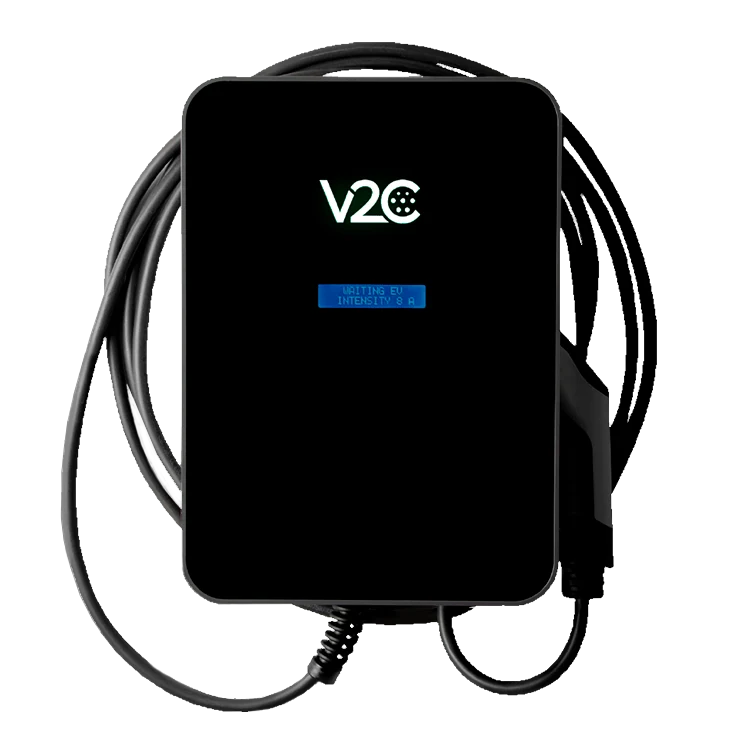
Trydan
Trydan, ready for the outdoors
IP54 / IK10 and operation from −25 to 50 °C, so it charges outside all year round.
- Up to 22 kW
- WiFi and Bluetooth
- IP54 / IK10, −25 to 50 °C
Wall-mounted or pedestal: which suits your driveway?
If there is a wall close to where you park, a wall-mounted charger is the simpler and cheaper option; with no suitable wall nearby, an impact-resistant post anchored to the ground is the alternative. The deciding factors are the distance from your consumer unit and the side your car’s charging port sits on.
Wall mounting is usually the most economical: the supply runs along the wall in protective conduit, with no trenching. A compact wall-mounted unit fits neatly on a sheltered wall where the cable reaches your car’s port without resting on the ground.
When a post makes more sense than a wall
When the parking space sits in the open, away from any wall, the charger goes on a pedestal. V2C offers single and double posts compatible with Trydan, with the double post taking two chargers. The supply has to reach the post, usually through a buried duct, which is the item that weighs most on an outdoor quote.
In every case, your installer sets the mounting height from the charger manual: a readable screen and a connector that is easy to stow. Check that the unit is clear of passing traffic, safe from car doors in tight manoeuvres, and that your home Wi-Fi reaches that far.
What else matters for an outdoor charging point?
A good outdoor charger adjusts its power in real time to your home’s consumption, can charge from your solar panels, and is controlled from an app, all of which count for more when the charge point is not in plain sight. These features keep charging cheap, safe and hands-off.
Dynamic power control to avoid tripping the fuse
With dynamic power control, V2C Cloud measures your whole home’s consumption in real time and adjusts the charging current so the main fuse never trips. It is especially useful on outdoor installations with a limited supply, where the oven, the heating and the car could otherwise overload the connection. On Trydan, the V2C ControlBox and its current clamp are always included.
Charging from solar outdoors
If your home has panels, the charger can run on surplus solar energy, topping up your car for next to nothing in daylight. V2C offers wireless solar integration with GoodWe, Fronius, Huawei, SMA and SolarEdge inverters, which keeps the wiring on an outdoor charge point simpler, since there is no extra cable to run back to the inverter.
Checking and controlling the charger remotely
From the free V2C Cloud app you can start and stop a session, lock and unlock the charger, schedule off-peak charging and see live energy flows, all without walking out to the driveway. That matters outdoors, where glancing at the unit means stepping into the rain. Overnight charging is also the cheapest way to keep your electric car range topped up.
Good to know
Dynamic power control lets an outdoor charger share a limited supply with the rest of the house without ever tripping the main fuse.
Charging two cars outdoors from one point
A dual-socket outdoor charger lets you charge two vehicles at once from a single installation, which suits households with two electric cars and one outdoor access point. Instead of two separate units and two supplies, you run one charge point and split the power between the cars.
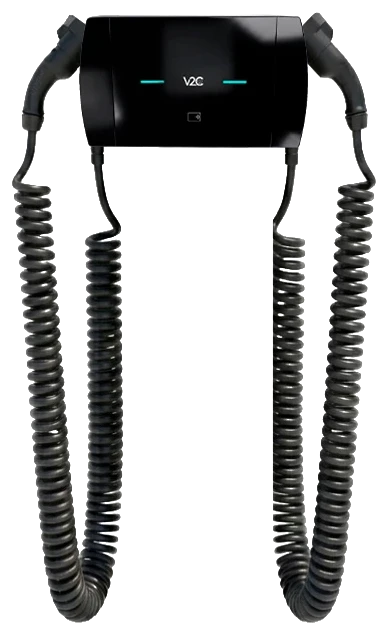
Alva does exactly this: two Type 2 sockets at up to 7.4 kW or 22 kW per socket, in a single IP54 / IK10 enclosure measuring 450 × 260 × 300 mm. It includes an RFID reader to identify different users and an optional MID meter, so it also works for a shared outdoor space where each car’s energy needs to be measured.
Alva
Alva, two cars from one point
Dual Type 2 sockets up to 22 kW each, with integrated electrical protections.
- Charges two cars at once
- Up to 22 kW per socket
- 4G, Ethernet and RFID reader
How much does an outdoor EV charger installation cost in the UK and Ireland?
Outdoors, the cost depends above all on the distance from your consumer unit and any trenching needed to reach the parking space: more cable and more groundwork push the quote up. The cable run itself is a key variable, and our guide on what size cable for ev charger explains how it is sized.
The UK EV Chargepoint Grant
According to Gov.uk, the EV Chargepoint Grant covers 75% of the cost of buying and installing a charge point, up to £500 per socket, for renters and flat owners with private off-street parking. The scheme runs until 31 March 2027 and requires an OZEV-authorised installer.
The SEAI Home Charger Grant in Ireland
In Ireland, the SEAI EV Home Charger Grant offers up to €300 towards buying and installing a home charger, according to seai.ie. The charger must appear on SEAI’s Smart Charger Register and the work must be carried out by an electrician registered with Safe Electric Ireland, so choosing an approved installer comes first.
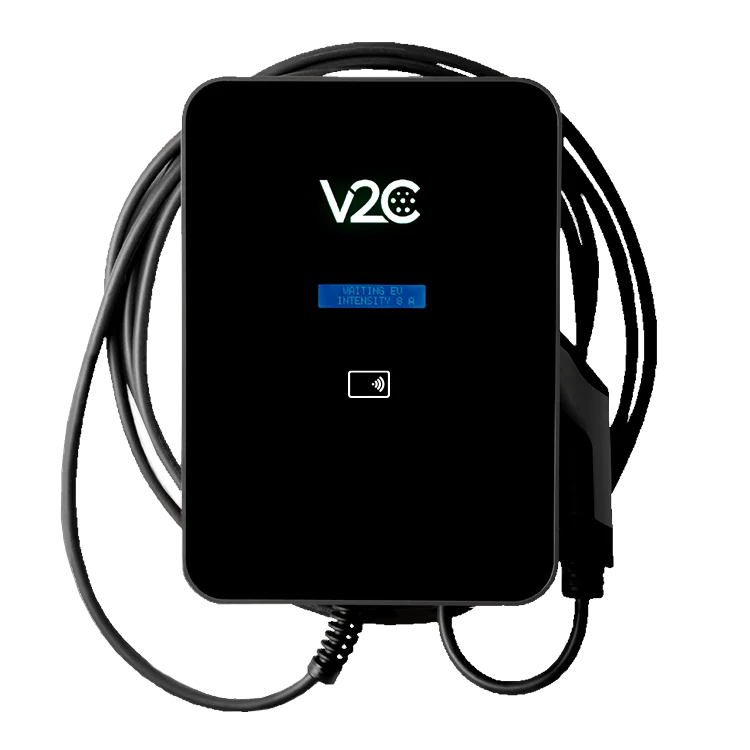
Trydan Pro
Trydan Pro for shared parking
Everything Trydan offers plus 4G with SIM included, Ethernet and an RFID reader for several users.
- Everything in Trydan
- 4G with SIM included and Ethernet
- RFID reader
Best outdoor EV chargers compared
For a single home, Trydan covers IP54 / IK10 and dynamic power control; Trydan Pro adds 4G and multi-user control for shared or small-business use; and Alva lets you charge two cars at once from one outdoor point. All three are designed and manufactured by V2C in Spain and share the same IP54 / IK10 weatherproof rating.
| Feature | Trydan | Trydan Pro | Alva |
|---|---|---|---|
| Protection | IP54 / IK10 | IP54 / IK10 | IP54 / IK10 |
| Outlets | Single Type 2 | Single Type 2 | Dual Type 2 (two cars at once) |
| Operating temperature | −25 to 50 °C | −25 to 50 °C | Built for façades and outdoor car parks |
| Dynamic power control | Yes | Yes | Yes |
| Solar charging | Yes | Yes | Yes |
| Best for | Single homes | Shared use, several users, small businesses | Two EVs, buildings and businesses |
Trydan
Trydan suits a single home outdoors: an IP54 / IK10 MVR polycarbonate enclosure, −25 to 50 °C operation and dynamic power control through the V2C ControlBox, which is always included with its current clamp. It measures your home’s consumption in real time so the main fuse never trips. You can see the full spec on our Trydan product page.
Trydan Pro
Trydan Pro has every feature of Trydan and adds 4G with a SIM included, Ethernet and an NFC/RFID reader for several users, plus the V2C SmartLock proximity-detection system and remote management through V2C Cloud. It is OCPP 1.6J compatible, which makes it a strong fit for rentals, shared driveways and small businesses. The details are on our Trydan Pro product page.
Alva
Alva is built for façades and outdoor car parks: IP54 / IK10, up to 22 kW and two Type 2 sockets to charge two vehicles at once with no external components. It integrates electrical protections, an optional MID meter and supports V2C Payments to bill each session. There is more on our Alva product page.
Good to know
Choose Trydan for a single home, Trydan Pro when you need 4G and several users, and Alva when two cars share one outdoor point.
Finding a qualified installer for your outdoor charge point
An outdoor charge point should be fitted by a qualified installer, who designs the circuit, chooses the protections, mounts the charger and handles the outdoor fixing and cable routing. In the UK that means an OZEV-authorised installer; in Ireland, an electrician registered with Safe Electric Ireland, so your grant stays valid.
V2C does not carry out installations, but our international network of qualified installers matches you with a professional near you, backed by an installation guarantee and ongoing technical support once the work is done. To arrange a site visit for your driveway or outdoor parking space, you can find an installer from the V2C network in your area.