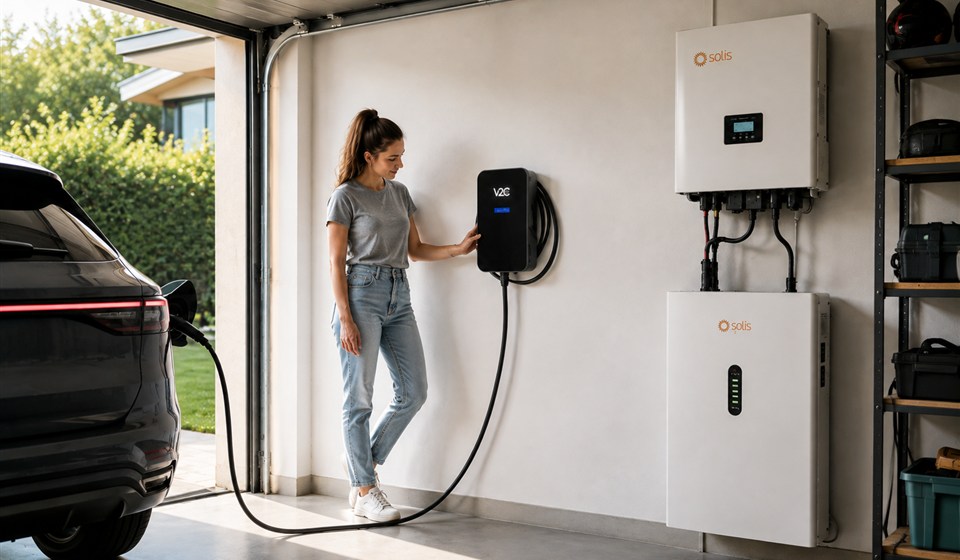
In Great Britain, suppliers that sign up solar owners to the Smart Export Guarantee (SEG) must offer to pay for the electricity you export, but each supplier sets its own rate. Whatever the rate, a solar kWh that goes straight into your car is a kWh you do not have to buy from the grid. If your solar installation has a Solis inverter, you need a charger that talks to it reliably.
At V2C, as designers and manufacturers of electric car chargers in Europe, we make that possible with Trydan, a charger that connects to Solis inverters over a wired RS485 Modbus link, without depending on WiFi or your router, and adjusts charging to your solar surplus.
The short version
- Solis is listed in the V2C support guide among the inverters that connect to Trydan by cable.
- For communication with Trydan, Solis uses a wired RS485 Modbus connection.
- The Solis S6-EH1P6K-L-PLUS hybrid has its own connection procedure; other models follow the generic one.
- Setup is done in the V2C app under Dynamic Power Control, choosing a Solis inverter.
Table of Contents
- 1 What do you gain by charging your car from a Solis inverter?
- 2 Why does an RS485 cable give a more stable connection?
- 3 What are the two ways to connect Trydan to a Solis?
- 4 How do you set up Trydan in the V2C app?
- 5 What maintenance does the connection need?
- 6 What happens to your solar surplus in Great Britain?
- 7 What if you do not have a Solis inverter?
- 8 Who benefits most from linking Solis and Trydan?
- 9 How does Solis compare with other inverter brands?
- 10 In short
- 11 FAQs
What do you gain by charging your car from a Solis inverter?
Solis makes string inverters and hybrid models with battery storage. If you already have a Solis installation, you can charge your car automatically with your own solar production, without adding any metering hardware, as long as your inverter has an RS485 port, which you can confirm in your model’s manual. That holds for a new installation and for one that has been running for years.
Trydan reads production data in real time through the inverter’s Modbus interface. It therefore knows how much solar power is being produced, how much the house is using and how much is left for the car. The charger follows changes in production, for example when a cloud passes.
Solis joins a list of compatible brands that already includes Huawei, Fronius and SMA, each with its own communication protocol. With Solis the link is a cable, a detail that works in favour of stability.
Why does an RS485 cable give a more stable connection?
For communication with Trydan, Solis uses a wired RS485 Modbus connection, which makes the setup more solid: the link does not depend on WiFi coverage or on your router.
RS485 Modbus (wired)
Stable connection
A fixed cable between Trydan and the inverter. It does not depend on WiFi coverage or your router.
Modbus TCP (Fronius, SMA)
Local network connection
No extra cable between the devices; the link runs over your home network.
Once wired correctly, the link between Trydan and the inverter stays in place even if you restart your router. A new WiFi password or a router update does not affect it either.
RS485 Modbus is an industrial communication standard widely used in building and plant automation, so transmission is robust and not very sensitive to interference. Once the wiring is done properly, you will not need to think about it again.
What are the two ways to connect Trydan to a Solis?
Trydan supports two wired connection variants with Solis inverters: the generic procedure and a specific procedure for the Solis S6-EH1P6K-L-PLUS hybrid.
| Solis model type | Procedure | Connection |
|---|---|---|
| Other models (string and hybrid) | Generic procedure | RS485 with a dedicated connector and UTP cable |
| Solis S6-EH1P6K-L-PLUS (hybrid) | Specific procedure | RS485 as described in the V2C support guide |
In the generic procedure, a dedicated connector supplied by the manufacturer plugs into the inverter’s COM port. The two RS485-A and RS485-B wires are then connected to an RJ-45 plug, which goes into Trydan’s RS485 input. For the exact pin assignment, follow the official V2C support guide, where every step is documented.
For the S6-EH1P6K-L-PLUS, the support guide gives the procedure and the settings to apply. In the app, set the installation profile to HYBRID, a critical setting. Follow the guide exactly as written so the connection works first time.
Which connection suits your Solis?
The procedure that applies to you depends on the model. Check your inverter model in its manual and compare it with the V2C support guide. If you are unsure, ask a V2C charger installer or write to V2C support with your inverter model, your electric car and your postcode, and we will help you choose the right option.
How do you set up Trydan in the V2C app?
- Open the V2C app and select your charging point.
- Go to the Dynamic Power Control (DPC) settings.
- Choose Inverter as the device type.
- Select Solis as the inverter type.
- Choose the installation that matches your system.
- Save the settings to activate dynamic power control.
Once the link is active, Trydan continuously adjusts the charging power to the available solar surplus, within the limits of your Trydan version. If production drops, for example under cloud, charging power falls automatically, with nothing for you to do.
To check that everything works, look at the app: when Trydan receives data from the inverter, solar production and home consumption should appear. If no values show, a good first step is to check that the RS485-A and RS485-B wires are not swapped and that the cable is in the correct inverter port.
What maintenance does the connection need?
A wired RS485 connection needs very little maintenance after commissioning. Unlike a WiFi pairing, there are no passwords to change. If the app stops showing values after you update the inverter’s firmware, write to V2C support and we will check it with you, so you are back to charging with your solar surplus as soon as possible.
A common mistake at commissioning is swapping the two RS485 wires. If A and B are reversed, Trydan does not detect the inverter even though the physical connection looks right. Swapping the two wires at the connector is enough, with no need to redo the cabling.
What happens to your solar surplus in Great Britain?
In Great Britain, the Smart Export Guarantee requires larger licensed suppliers (those with at least 150,000 domestic customers) to offer at least one export tariff, and smaller ones may also offer one; the rate must always be above zero. Payments, including the amount and the contract length, are set by the supplier you choose, and you can apply to any SEG licensee, not only your own electricity supplier. Every solar kWh you use directly to charge your car replaces a kWh you would otherwise buy from the grid, so it is worth comparing that value with your export rate. Rates change often, so check the current tariffs before you decide.
Self-consumption and export work together. What you charge with Trydan during sunny hours is self-consumed; the rest is still exported under the tariff you chose. If you are outside Great Britain, the rules for exporting surplus differ by country, so check them with your supplier or installer.
What if you do not have a Solis inverter?
If your installation has another inverter, or a model that does not allow direct communication, you can use a current clamp. It measures power at the grid connection point and lets you charge with solar surplus whatever the inverter model, with a slightly slower response than a direct connection. It can also serve as a stopgap if you plan to change inverter.
Requirements at a glance
- Solis inverter, string or hybrid
- RS485 port on the inverter (check your model’s manual)
- UTP cable with an RJ-45 plug for the connection to Trydan (generic procedure)
- V2C app with Dynamic Power Control enabled
The wiring is a simple data line between two devices that are already installed, but we recommend leaving it to your charger installer, in the same visit as the installation, especially if a different company manages your solar system or the inverter is under warranty. That way everything is documented and set up properly.
Who benefits most from linking Solis and Trydan?
The effect is clearest in homes with a solar system of reasonable size and an electric car that spends a good part of the day at home. In that case, a large share of the charging is covered directly by your own solar power.
If you also have a battery, for example with a Solis hybrid inverter, the V2C support guide explains how to set up each Solis variant for your installation.
How does Solis compare with other inverter brands?
Unlike Fronius or SMA, which connect over Modbus TCP on the local network, Solis connects by RS485 cable. Both approaches lead to the same result, charging with solar surplus in real time, and differ in commissioning: with Solis there is no network configuration, in exchange for physical wiring done once. The better choice depends on how far the inverter is from the charger.
In short
A Solis inverter connects to Trydan by cable, without depending on WiFi or your router and without extra metering hardware. The fixed RS485 link makes the combination very robust, and setup in the app is simple. If you already have a Solis installation, the next step is easy: find your charger installer in our professional network and plan the installation of your electric car charger to drive on your own sunshine.
FAQs
V2C’s Trydan connects to Solis inverters over a wired RS485 Modbus link, without depending on WiFi or your router. Solis is listed in the V2C support guide among the inverters connected by cable, both string and hybrid.
The V2C support guide describes the connection of Solis string and hybrid inverters. The S6-EH1P6K-L-PLUS hybrid has its own procedure and the other models follow the generic one. If you are unsure about your model, ask a V2C charger installer or write to V2C support and we will confirm.
No: for communication with Trydan, Solis uses a wired RS485 Modbus connection. This makes the link stable, because it works independently of your home network.
In the generic procedure you need a dedicated connector supplied by the manufacturer and a UTP cable with an RJ-45 plug. For the S6-EH1P6K-L-PLUS hybrid, follow the procedure in the V2C support guide.
You can use a current clamp. It measures power at the grid connection point and lets you charge with solar surplus whatever the inverter model.
Trydan reads the inverter’s production data in real time and adjusts charging power to the available solar surplus, within the limits of your Trydan version, with nothing for you to do.
The material is a dedicated connector and a UTP cable with an RJ-45 plug. The actual cost depends on your installer and, if the wiring is done with the charger installation, it can be part of the same visit.
We recommend your installer does it at the same time as the Trydan installation. It is a data line between two devices that are already installed: just plan it into the same visit.