
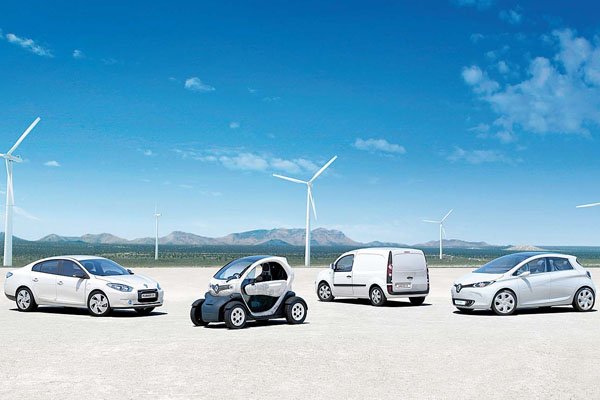
The electric vehicle sector will be analyzed at the specialized fair on charging infrastructure and electromobility, which will take place for the first time from June 20 to 22 in Munich (Germany). The sector will have its first meeting at Power2Drive Europe. But before this much-anticipated event, a document has already been published highlighting the importance of electric fleets in companies and the business benefits of incorporating electric vehicles into businesses and administrations. These are the arguments.
Electric vehicles are becoming an increasingly attractive option not only for individuals but also for companies and public administrations. Why are these electric vehicle fleets increasing? Basically for two reasons: Electric cars are achieving greater autonomy, and the costs of acquisition and maintenance are decreasing.
As companies and administrations need to replace their fleet of commercial vehicles or municipal vehicles, they are already asking the question: Should we acquire electric vehicles or combustion engine vehicles? This is because commercial fleets represent a significant investment, and the analysis of the purchasing decision must consider numerous variables. By 2020, according to the IFA, German Institute for Automotive Industry, it is expected that the total cost of ownership of an electric vehicle, including acquisition, electricity consumption, maintenance, and repair, will continue to decrease, becoming 3.2% cheaper than conventional combustion vehicles, not counting the subsidies that administrations offer to consumers.
When does an electric vehicle become more profitable for companies?
The electric vehicle fleet is profitable from the moment of acquisition. In the recent publication from Power2Drive, it is highlighted that today the purchase price barely differs between combustion and electric cars. And in the case of industrial vehicles that are used and amortized under leasing, it is increasingly advantageous for companies to opt for the electric variant.
For this reason, the argument of purchase price is no longer a valid argument for combustion cars.
In the aforementioned publication from Power2Drive, an analysis of the current situation in Germany can be read. The publication states that there are approximately one million small or medium-sized industries in this country, around 100,000 architects, and tens of thousands of engineering companies. Most of them operate within a radius of 50 to 100 kilometers, or even shorter distances in cities. Electric vehicle fleets are an attractive alternative here, especially because improved battery technologies now allow them to cover even greater distances of between 300 and 600 kilometers. Even with a shorter range, electric mobility is suitable for elderly care visits, municipal and private rescue services, waste management operations, and vehicle fleets for municipal service companies. Innovative mobility solutions for administrations and citizens are the future option for municipal services.
And all this without forgetting medical transport, a service that represents approximately ten million trips per year in Germany. The shift to electric vehicles will not only help control costs; the generation and use of clean and renewable energy are also an important contribution to the future of energy.
However, all these positive and optimistic data will not be sufficient without adequate infrastructure. Electric vehicle charging for company fleets must be available at strategic locations for the company.
This publication also includes some interesting comparisons regarding electric fleets and car-sharing: the ideal couple (according to the study). The document states that there is an economic alternative for companies compared to cars powered by combustion engines, which is the use of electric fleets and car-sharing systems. This is because after comparing electric models and their combustion counterparts, we can conclude with the following data.
The electric Golf already scores better than its combustion counterpart, as demonstrated by a cost comparison from the German automobile club ADAC: based on a distance of 10,000 kilometers per year, the car costs 63.2 cents per kilometer. The gasoline version is 0.3 cents more expensive, and the diesel costs the user 5.7 cents more per kilometer.
Another example: “If we compare the Tesla models from the X and S series with the corresponding combustion models from BMW, Audi, and Mercedes, the electric variant is also more cost-effective: calculating 10,000 kilometers per year, the Tesla S 75D costs 144.2 cents per kilometer, 28.5 cents less than the BMW 640i (172.7). The BMW 640d costs 177.5 cents.”
And not only are the figures favorable for cars intended for individuals, the same applies to industrial vehicles. The costs also lean in favor of electric fleets. “The Nissan e-NV200 Kombi Premium costs, calculating also 10,000 kilometers per year, 61.6 cents per kilometer. Its gasoline and diesel counterparts cost 62.5 and 64.4 cents, respectively, making the kilometer at least 0.9 cents more expensive.”
Furthermore, according to Power2Drive, thanks to car-sharing systems, companies increase efficiency and do not need to purchase as many cars. And in light of projects to prohibit traffic in some major cities, such as Stuttgart, Munich, or Berlin, shared-use systems are a step further towards a sustainable and future-adapted traffic system.
Taxis are also a form of car-sharing: “If the approximately 55,000 taxis in Germany were electric, they would be an important component for the transformation of transport. Their advantage: they would still be able to access city centers, which is undeniable for the taxi sector and, therefore, the basis of the business.”