
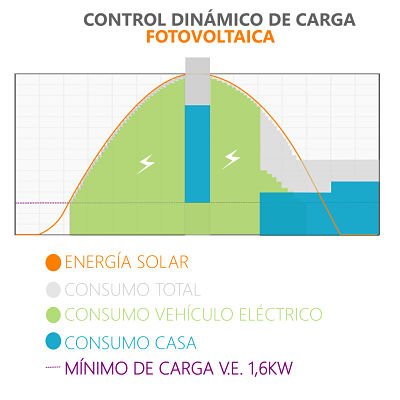
Thanks to the addition of dynamic load balancing or dynamic power control to some charging points like the Dark Wallbox, we can now charge our electric vehicle while maximizing the use of renewable energy and solar panels.
Dynamic power control for photovoltaic installations is an intelligent sensor that allows for the regulation of the power transformed by photovoltaic inverters and the contracted grid energy while charging our car.
Table of Contents
How does it work?
To control the power supplied to the vehicle, the charging point must continuously monitor the consumption of the household devices.
When we first set up the wallbox, we note the maximum power available from the electrical grid, the contracted power.
To determine what electricity will be supplied to the vehicle, the charging point takes into account at all times:
– Household consumption
– Vehicle consumption
– Electricity generation from the photovoltaic installation
Types of charging
The generation of electricity through our photovoltaic installation allows for various uses through dynamic load balancing:
– Charge our vehicle solely with the surplus of solar electricity generation: In this case, we practically avoid consuming from the electrical grid. The wallbox measures at every moment the surplus generated by the panels, which is: the photovoltaic generation minus the household consumption. The system checks if the available electricity generated by the panels, after deducting the household consumption, is greater than the minimum power of the vehicle. If so, all the surplus photovoltaic power will be sent to the vehicle. If there is not enough power, the vehicle charging will stop until sufficient power is available.
– Charge our vehicle with a safety margin: In case there is not enough power from the photovoltaic installation, the minimum electricity will be taken from the electrical grid so that the vehicle never stops charging. This is especially interesting for cases where we want the vehicle to ideally charge from solar energy, but we want to ensure that the car charges without risks. For example, if the sky becomes cloudy and there is not enough surplus solar power, with this configuration the vehicle will continue charging (as long as the electricity consumed from the grid does not exceed the contracted power).
– Perform a maximum power charge by combining the surplus and the available contracted power: This allows charging even above the contracted power, which is very interesting for times when we have an urgency. In this configuration, the Dark constantly monitors the surplus of photovoltaic power and the available power from the electrical grid and assigns it completely to the electric vehicle, allowing the charging to be faster than what the photovoltaic installation and the electrical grid would allow separately.
Zero consumption
The main objective of this sensor is to reduce the consumption of grid energy and prioritize the power generated by solar panels, allowing us to approach or even achieve zero consumption. This leads to a reduction in the bill and, of course, the use of 100% clean electricity for both the home and the electric car.
Additionally, through the three configurations mentioned, V2C’s dynamic load balancing system allows for continuous adjustment of the power supplied to the vehicle, according to the selected configuration. The versatility of the charging point is ideal for any user with a photovoltaic installation and an electric vehicle.